





For a long time, feminist was considered something of a dirty word. My mother told me not to call my upcoming novel, Grace and Fury, about two sisters fighting for agency—and each other—in a patriarchal world “feminist,” for fear it would turn off potential readers. But with the #MeToo movement, the increased interest in and timeliness of The Handmaid’s Tale (both the novel by Margaret Atwood, and the Hulu show inspired by it), and the general state of the world, it feels like the word feminist is becoming more and more a call to action—and a promise.
Personally, I love feminist books, especially those that reexamine and subvert traditional stories, giving their female characters the full range of experience and emotion that male characters have always been allowed. Here are some of my favorite (and a couple I’m dying to read!) science-fiction and fantasy retellings, written by five talented female authors who re-imagine classic novels, fairy tales, and history itself through their powerful feminist gazes.
 Spindle’s End by Robin McKinley
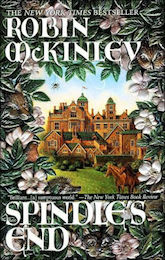
I have been a Robin McKinley reader and fan since the eighth grade, when my teacher asked us to read her first novel, Beauty, a retelling of “Beauty and the Beast.” I would argue that all of McKinley’s writing is feminist, full of female characters discovering their own power and place in the world, but Spindle’s End is particularly reflective of this. It retells a tale that’s notoriously unfeminist—the story of “Sleeping Beauty.”
The original fairytale strips all power and agency from its heroine, reducing her to a body waiting for the kiss of a handsome prince, a kiss she cannot even consent to. McKinley upends the tale completely. She gives us a princess who is saved not by a man but by her own resourcefulness, the power and love of the women who have raised her, and her friendship with another teenaged girl. It’s difficult for me to think of another story that gives friendship and support among girls such an important role, and yet these friendships are vitally important to the girls and women reading her books. And when, at last, it’s time for the kiss to wake the princess, McKinley puts an entirely new and powerfully feminist spin on that moment.
 Cinder by Marissa Meyer
 Cinder
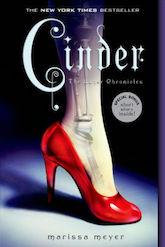
Much like Sleeping Beauty, the fairytale of “Cinderella” is not known for having a proactive protagonist. Cinderella is traumatized by her evil stepfamily before being whisked off to the prince’s arms by a kindly fairy godmother and a makeover. Marissa Meyer’s Cinder gives the fairytale a science-fiction edge, reimagining Cinderella as a cyborg who earns her keep not by sweeping the fireplace but by working as a mechanic in a dystopian, futuristic New Beijing. Meyer gives Cinder full agency and a much larger role, both in her own future and the future of her planet. She still has an evil stepmother but meeting the prince is just the beginning of Cinder’s story.
 Across a Star-Swept Sea by Diana Peterfreund
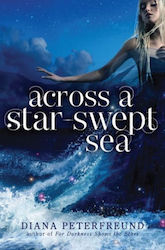
In Across a Star-Swept Sea, Diana Peterfreund retells The Scarlet Pimpernel by Baroness Orczy in a fresh, feminist way, recasting the titular character as a teenaged girl. In this case, no one on the islands of New Pacifica suspects that the “Wild Poppy,” a ruthless, clever spy, is actually vapid socialite Persis Blake. Peterfreund subverts female stereotypes by using the very assumptions people have about Persis as the tools she uses to become a successful spy and to keep herself safe.
 The Queens of Innis Lear by Tessa Gratton
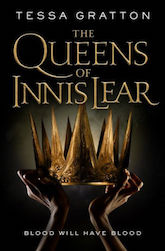
In Tessa Gratton’s epic fantasy retelling of Shakespeare’s King Lear, the king’s daughters take center stage, and they are allowed all the complexity, ambition, and bloodlust of their male counterparts. Gratton plays with and subverts the original material, creating a masterful tale with its own sharp-toothed feminist bite and a twist on Shakespeare’s ending.
Unconquerable Sun by Kate Elliott
Nebula award-winning author Kate Elliott is known for her inclusive, feminist writing, and I’m chomping at the bit to get my hands on the novel she has coming out in Fall 2019. She describes it as a gender-bent Alexander the Great set in a space opera, and she says it fulfills one of her long-held desires: “To write a woman as a truly charismatic leader of the legendary kind so much of our literature (and historical memory) reserves only for men.” I am here for this feminist, science-fiction retelling of one of histories most storied figures.
 Tracy Banghart grew up in rural Maryland and spent her summers on a remote island in northern Ontario. All of that isolation and lovely scenery gave her the time to read voraciously and the inspiration to write her own stories. Always a bit of a nomad, Tracy now travels the world Army-wife style with her husband, son, cat, and sweet pupper Scrabble. She wrote Grace and Fury, now available from Little, Brown, while living in Hawaii. Its sequel will follow in July 2019.


Cinder is just the first of the series. Entries also include Scarlet, Cress, and Winter (Riding Hood, Rapunzel, and Snow White, whose stepmother is the antagonist of the series.) There’s also a prequel from the stepmother’s view. Frankly, it’s one of the most fun YA series I’ve read in a while, and my favorite subversion is Rapunzel’s tower.
Elizabeth I, Isabella of Castile, Joan of Arc, Boadicea, Grainne O’Malley, PrincessPingyang of T’ang… Yeah no legendary female leaders in RL.
Sorry, double post.
@princessroxana, Would you say any of those women has the kind of legendary reach and glow that Alexander has? I’m not trying to be argumentative — it’s truly a question, not a challenge. I don’t, so I do see a difference between the women you list and Alexander. I also don’t see any of those women as having the geographical reach Alexander had.
Are there any other men with the legendary reach of Alexander? But actually there is one, Semiramis. Granted she never existed as described but we’re talking legends. Then there’s Tomyris who defeated Cyrus the Great. Or Myrhinna, the great Amazon conqueror.
@princessroxana — Thank you for the info. Much appreciated…
Adapting a man’s life undermines the goal of demonstrating that women can be legendary figures too. There are many real women whose lives could inspire an epic. Why not Ching Shih, Theodora, or Boudicca? Ignoring all of the worthy historical women in favor of Alexander the Great reinforces the idea that there are no women of similar merit.
The Empress Theodora is not only an example of a Great Woman but of such a woman being appreciated by a Great Man who voluntarily makes her his full partner in power.
Personally I am surprised how often Imperial Russia was ruled by women.
Does “He, She, and It” by Marge Piercy count? A pretty politically feminist reimagining of the story of the Golem.
This list is whiter than all the snow in Antarctica.
As Justina Ireland puts it, maybe you need to expand your circle of friends? Be more inclusive, you know?
Tam LIn by Pamela Dean. Nuff said.
Artimis: I love expanding my reading! Looking forward to your list of suggestions.
“…all the complexity, ambition, and bloodlust of their male counterparts.”
Wait, what? There’s a lot of complaints that can be levelled at Shakespeare’s plays. For one, the male characters vastly outnumber the female characters, and for another, frequently the sexual politics are… troubling. As an example, at the end of Much Ado About Nothing, one of the villains is punished by being forced into marrying below his station, to the innocent maid he drew into a nefarious scheme. Her “reward” for helping reveal and foil the nefarious scheme is marrying above her station into nobility. *That’s* going to be a happy marriage.
And yes, a lot of the drama for the female characters comes from the conflict between what they need to do and the social restrictions placed upon them by their societies perception of their gender. They frequently find the only way to escape those restrictions is to cross-dress, but that’s another conversation.
To say, particularly of King Lear, that Shakespeare’s female characters don’t show “all the complexity, ambition, and bloodlust of their male counterparts” seems (to me, at least) misjudged. With exception of Lear himself, all the male characters seem almost 2 dimensional next to the three daughters. Any display of ambition or bloodlust comes either directly from the two oldest daughters, or at their urging or instigation.
Full disclosure: I haven’t read the Queens of Innis Lear. I’m always a bit wary of adaptions of Shakespeare. I’m a bit old school, and prefer the plays in the original Klingon. That being said, I can see how Shakespeare’s plots could benefit from a modern worldview, with the fantasy element explaining the anachronism. Yet I find it odd that someone can see King Lear and think that the two older sisters aren’t the two most blood-thirsty and ambitious characters in the play. So the accusation that the female characters are somehow shortchanged compared to their male counterparts on “complexity, ambition, and bloodlust” just seems… odd.
One thing you got to say for Shakespeare” women is they are three dimensional. Though limited by the norms of the age in which he wrote.
@15: I’ve acted in Much Ado About Nothing, and that didn’t happen. Perhaps a different play?
@17: Measure for Measure, I think: at the end, Angelo’s sentence is that he has to marry Mariana, though when the Duke passes that sentence Angelo is also going to be executed, which would give Mariana status as his widow without actually having to endure marriage with him.
Many strong female characters n Shakespeare and in the comedies they are often smarter and more sensible than the men.
@18, as I recall Mariana is Angelo’s betrothed wife who he’s abandoned and his choice is execution or go back to her. The poor deluded woman is in love with him and ready to welcome him back with open arms. Or am I getting plays confused too?
No, just looked it up. There’s a subplot though resolved by a trouble maker being forced to marry the prostitute he impregnated.
@17/AeronaGreenjoy – I speak of Borachio and Margaret in Much Ado About Nothing. It’s not at the end of the play, but Hero’s father speaks of him coming face to face with Margaret and righting the dishonour he did her. As nobody had suspected her of wrong-doing until Borachio’s confession, and how adamant he is of her innocence in his skulduggery (which suggests hope for them), what else would this be other than redeeming by marriage the wantoness she displayed when mistaken for Hero? Then later we have Benedick’s banter with her about being raised from “below the stairs” by marriage, which seems an obvious reference to marriage raising her station (not far, as Borachio seems a minor noble at best, but still more than a servant). Of course, I may be reading too much into it, but in all the productions I’ve seen, when you have all the happy couples pairing off (as everyone but Don Pedro and [off-screen] Don John seem to have paired up) in the background crowd (without lines) Borachio and Margaret are together. Which is as likely to do with small casts than the script, I concede, but still, they seem together.
I’m not sure but I get the feeling that Shakespeare’s subtext is Margaret wouldn’t have ended up in such a compromising position if she’d had a husband, and having a husband would keep her from getting into trouble in the future. <shrugs> or I could be reading too much into it again.
@20/PrimcessRoxana – yes, I like Measure for Measure, despite it being one of the “problem plays”. The Duke’s sparing of Angelo always strikes me as how persuasive Isabella is, when Mariana appeals to her to help save Angelo’s life (and how forgiving Isabella is, given Angelo had sentenced her brother to death). Especially when you consider that the Duke (arguably the antagonist) sets just about every plot in the play in motion motivated by a combination of boredom and dislike of Angelo.
I also like how Isabella is the protagonist and how Shakespeare left it ambiguous as to whether she accepted the Duke’s off-hand marriage proposal, or returned to her convent to take her final Holy Vows.
@21, ah Borachio and poor Margaret, who is seduced to harm her mistress, how must that make her feel? Humiliated, used and furious I would guess. The fact that Borachio fiercely defends her rather than casually dismissing her as a whore strongly implies he’s come to care for her.
https://en.wikipedia.org/wiki/List_of_queens_regnant
I always found this list to be illuminating. It’s a list of all queens who were true rulers of their countries. There are hundreds more than expected, and sadly I’ve only heard of a handful. I wish people would write about a few because I can’t find any information about most.
I would say Elizabeth I and Catherine II (and to a lesser degree Victoria) had the reach of Alexander in the scopes of their empires and influence, though not his warrior status.
This is a good list of books for people to start with. I’ve enjoyed them all.
@23/PrincessRoxana – he is rather fierce in her defence, isn’t he? Perhaps it would not be such a bad marriage, after all.
Lucio’s marriage in Measure for Measure, on the other hand… though I don’t think his fiancée Kate is a speaking role, so we don’t know her opinion of the “sentence”.
@24/Kate – yes, that list is fascinating. Particularly the female dynasty of Matamba. Veronica especially, but Barbara and Njinga as well
@25, At the very least Borachio regards Margaret as a wronged innocent, a good girl he’s treated badly. He has respect for her. Earning her respect in return won’t be easy but if he can they should do well.
As for Kate, she may be willing to put up with a lot in return for her children getting a name and an honorable start in life. She’s probably not a prostitute because she thinks itsia great career.
Spinning Silver by Naomi Novik may be of interest to readers of this essay.
Ana Mardoll’s Pulchritude is a good retelling of Beauty and the Beast. Her other books are worth looking at, too.
@22 I saw the RSC production of Measure For Measure many years ago, with the delightful Josette Simon as Isabella and in that last scene, without a word spoken, it was made clear that Isabella was not impressed with the Duke or interested in his proposal – and he knows it.
As a teacher librarian I bought Marissa Meyer books for my library on request by my female students, but never got around to reading them myself. The best Cinderella retelling I’ve read is Moonlight And Ashes by Aussie author Sophie Masson. She bases it on the Grimm version, Ashenputtel, which has no fairy godmother, no passive Cinders, but a mother’s love. The heroine goes to her mother’s hazel tree, which provides the ball gown, and makes her own way to the ball. However, that’s just the beginning. The Prince is not what she is expecting and she has to do some rescuing… The novel is set in the 19th century, in a fictional country where magic is banned except for those magic users working for the crown. Sort of a Psi Corps. Anyone else with magical abilities is taken away and never heard of again. Selena, as Cinderella is called in this book, has magical abilities…
@27/PrincessRoxana – Margaret obviously saw something entertaining in him, as she was willing to play dress-up for him. :)
With Kate’s career choice, it may be that she picked prostitution to escape an unwelcome marriage. Lucio has *some* redeeming features (after all, his first action on learning Claudio has been arrested is to fetch Isabella to sort things out), but he’ll control the purse strings, and we don’t know enough to know if he’ll properly support his wife and her child (particularly considering his dissolute lifestyle). Marriage may not be the more pleasant option.
@30/sbursztynski – yes, as Shakespeare didn’t write Isabella’s answer, it takes an actress of skill to convey her response non-verbally. I’m guessing modern productions tend to go with refusal, given how much the Duke acts as a Trickster God during the play. Imagine being married to that. <shudders>
i wonder if audiences varied between wanting the marriage and wanting her to refuse him, and Shakespeare wrote it so the actor could gauge the audience’s reaction during the performance and decide which way to go…
@31, back in the day even a bad marriage was regarded by women as better than prostitution. Remember we are sixteenth/seventeeth century people in Shakespeare’s plays. Sex outside of marriage was wrong but there were excuses. Selling yourself was beyond the pale and would destroy you not only in the eyes of society but your own. A woman would have to be desperate or have despaired of any alternative to become a prostitute.
Shakespeare’s play have a very bourgeois morality, sex outside of marriage is bad but can be redeemed by a wedding, adultery is always beyond the pale as is forced sex. Margaret has been over persuaded by love, the blame is Borachio’s and he knows it. By marrying her he makes it right. Kate is a victim of society and Lucio can and should make it right for her by marriage.
Tanith Lee.
Flat Earth series.
Rachel Pollack.
Unquenchable Fire.
Ada Lovelace.
Margo lanagan Tender Morsels.
Angela Slatter Bitterwood Bible,Sourdough,Girl with no hands.
Norman. Spinrad A World Between.
That’s a subtext I didn’t pick up on and nobody mentioned in my hearing. Just as well. I played Don Jon, played him well because his lonely anger matched mine,* and was irritated enough by the two happy couplings at story’s end. I didn’t need to know about a third coupling that might have proven happy.
*As one audience member said to another, “The little blonde woman who played the surly man was so…surly! She really shined, though.”
Hairesses of Russ anthology series.
Sorry should be.
Heiresses of Russ anthology series.
Beauty, by Sheri S Tepper
@@@@@33./princessroxana – I’ve been mulling it over and I still have my doubts. We’re not going to be able to say for sure unless someone invents a time machine to go back and do social comparison surveys, between modern and Elizabethan attitudes, but I suspect there’s more of a social stigma to prostitution today than there was in the first Elizabethan Age.
The Elizabethan woman’s choices were limited. Unless you were under the aegis of a husband or family unit, both accommodation and employment were hard to come by. From contemporary plays (about the only source I have to go on), it seems almost expected that a woman fallen on hard times would be forced to resort to prostitution. If she did, she had little to fear from the Law. The police didn’t exist as a concept, never mind an effective organisation. To be subject to it, she would need to attract the ire of someone with the authority, to motivate them to exercise their power. Otherwise, they seemed (at least in the plays) to ply their trade openly. When Shakespeare began his career, actors were considered little better than prostitutes. Indeed, prostitute and actress seemed almost interchangeable terms, which altered little as actors (not actresses) social status rose during Elizabeth I’s reign. Shakespeare and his ilk plied there trade in the same venues as prostitutes, and it’s been suggested they shared social circles. Shakespeare’s prostitute characters were often there for comic relief, but seldom unsympathetic. As for escaping the social stigma, a month’s travel would put you beyond where anybody would know your name, and you could reinvent yourself.
The perception for a modern woman (at least in western democracies) is that her choices are much broader. She’s no longer tied to a husband or family unit for accommodation and employment. This means those that “chose” (and yes, I’m aware that many don’t feel they have a choice) prostitution carry the stigma (in addition to the whiff of desperation shared with the prostitutes of the First Elizabethan Age) of being low-skilled and being unable to hold down a “proper” job (inferring drug-use or mental illness). The Police are both an established concept and take many forms, [supposedly] systematically enforcing the law, favouring none. As a result, the prostitute hides her profession, plying her trade in secrecy. Contemporary dramas don’t offer chances at redemption for “fallen” women, they offer stark warnings about how you can never escape your sordid past. The internet means that you can never travel far enough to ever escape your past self. You can try and reinvent yourself as much as you want, but your history will always be there lurking, ready to drag you back down.
Yet modern women still seem to feel that a choice between a bad marriage and prostitution is no choice at all, so become prostitutes. Is it really that unlikely that a woman of the First Elizabethan Age would see the “choice” from the same perspective?
@@@@@39/AeronaGreenjoy – to be fair, it’s not not explicit. Plus it might not have been that happy a marriage…
That sounds like you had a very perceptive casting director… I wouldn’t have wanted to be your director, though. And if they were the same person, well, someone liked a challenge. :)
Audience comments are often gold. Had one when our players were performing Measure for Measure, in the silence following the Monks reveal as the Duke, an older lady exclaimed “I knew it!” – obviously missing the earlier scene in which the Duke had acquired his Monk’s disguise…
@43/WillMayBeWise,
Surely men’s attitudes, then as now, were something along the lines of “Of course I respect you. In the morning we may all be dead! Now, get those clothes off! Puuleeeze! :)
@45/Keleborn – i’ve only heard of that strategy working once. Even then I doubt the veracity of the account… ;)
@46/WillMayBeWise,
Yes, that’s the problem with behaving like a cultural stereotype. Should someone be interested in pursuing a career in politics on the other hand …
I recently viewed the movie Summer of ’42. A 15 year old boy begins to feel it’s time to move on from the jerky attitude of his best friend, who can think of nothing else but “getting some”. He strikes up a friendship with a married woman in her 20’s whose husband is off fighting in the War. When her husband is killed in action, in a moment of grief and needing comfort, she wordlessly invites him the 15 year old young friend to make love. Although clearly not ideal behavior, in the context of the movie it seems to make at least some degree of sense. But tell that story with a young married man with a 15 year old female friend …
Some things, it seems, just aren’t equal.
@47/Keleborn – to be honest still felt uncomfortable reading your description. No matter how sensitively handled, and accepted she wasn’t in her right mind, the responsible adult was still selfishly satisfying her need for physical comfort while risking emotionally scarring the child (no matter how mature he seems or feels).
But I get what you’re saying. Society perceives it as less wrong. Maybe it’s because the potential consequences are different. The potential injuries to the psyche are equal for a male and female 15-year-old, but the physical risks are different. Research into the biological impact of parenthood is still a developing field, but we know any changes to the father are minor compared to the mother. Obviously a 15-year-old isn’t fully mature, so the has an impact on her late development.
Added to that is the societal expectation that the mother will be the primary caregiver. A burden the 20-something should be “ready” for, whereas a 15-year-old wouldn’t.
So, yeah, reasons. Maybe not good reasons, but reason.